Building Knowledge. One Step at a Time.
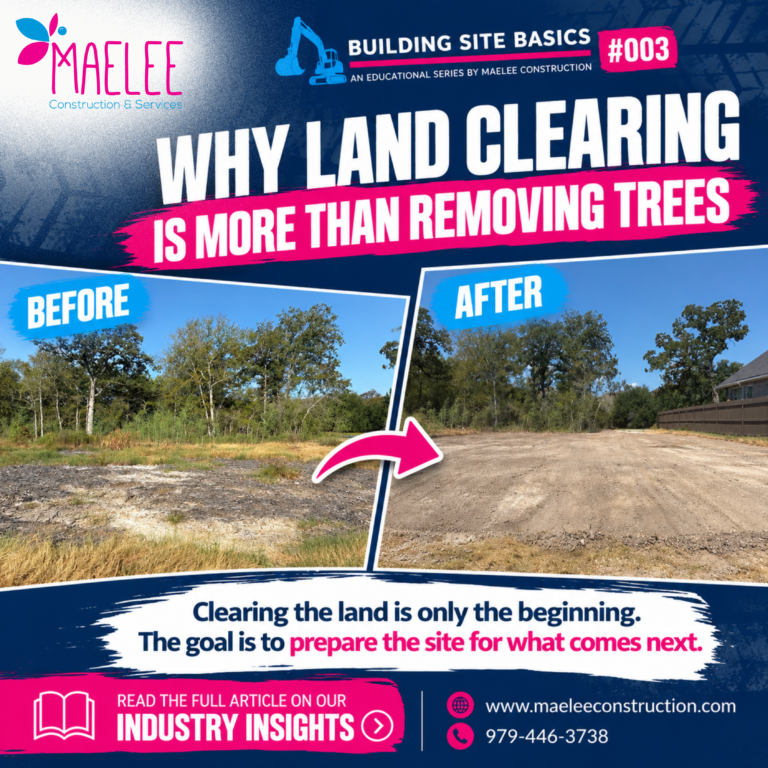
Building Site Basics is Maelee Construction’s educational series designed to help homeowners, builders, developers, and property owners better understand the groundwork behind successful construction projects. From site preparation and grading to drainage, demolition, and land development, each article shares practical knowledge from real jobsite experience to help you build with confidence.
Why Proper Grading Matters in the Build Process
When people think about preparing a property for construction, they often focus on what needs to be removed, what needs to be built, or how much dirt needs to be moved.
But one of the most important parts of site development happens in between.
Grading.
Grading is the process of shaping the land to achieve the elevations and slopes required for the project. It helps determine how water moves across the property, how the site transitions around structures, and whether the finished property will function the way it was intended.
It may not be something most people notice once a project is complete, but proper grading plays an important role long before the final structure is finished.
What Is Grading?
Grading is the process of shaping and adjusting the ground to achieve specific elevations and slopes.
The goal is not simply to make a property look flat.
A properly graded site is shaped according to the project’s plans, existing site conditions, drainage requirements, and surrounding elevations.
Grading may involve:
- Removing excess material
- Adding suitable fill
- Creating slopes
- Establishing required elevations
- Shaping drainage paths
- Preparing areas around future structures
- Creating transitions between different parts of the property
Every project has different grading requirements.
A residential homesite may require a different approach than a commercial development, driveway, or larger land-development project.
Why Does Grading Matter?
Water naturally moves downhill.
That means the shape and elevation of the ground directly influence where rainwater travels.
If a property is not graded properly, water may collect in low areas, move toward structures, or create drainage problems that become more difficult to correct later.
Proper grading can help:
✔ Direct water toward appropriate drainage areas
✔ Reduce standing water
✔ Protect areas around structures
✔ Improve site accessibility
✔ Create the elevations required for construction
✔ Support the overall drainage plan
✔ Create smoother transitions across the property
Good grading is about more than appearance.
It is about helping the property perform as intended.
Grading Is More Than Making the Ground Level
One of the most common misconceptions about grading is that the goal is to make everything flat.
That is not necessarily the case.
In many situations, a properly graded property needs carefully planned slopes to move water where it belongs.
A site can look perfectly level to the eye while still having elevation differences that are important to the construction process.
Professional grading considers the relationship between different parts of the property, including:
- Buildings
- Driveways
- Walkways
- Yards
- Drainage areas
- Property boundaries
- Existing elevations
- Future construction
The goal is to create a site where these elements work together.
What Happens Before Grading Begins?
Proper grading starts with understanding the property.
Before moving material, a site may need to be evaluated for existing elevations, drainage patterns, soil conditions, access, vegetation, structures, and the requirements of the project.
The construction plans also play an important role.
The grading approach needs to work with the proposed elevations and the phases of construction that follow.
Each part of the process needs to work together.
What Can Go Wrong With Poor Grading?
Improper grading can create problems that may not become obvious until after rainfall or after other construction work is completed.
Depending on the property and conditions, poor grading may contribute to:
- Standing water
- Erosion
- Muddy areas
- Drainage problems
- Water collecting near structures
- Difficult access for construction crews
- Problems connecting driveways and walkways
- Additional corrective work
The challenge is that once a project has progressed, correcting an elevation or drainage problem can become much more complicated.
Landscaping may already be installed.
Concrete may already be placed.
Structures may already be complete.
That is why grading is something to think about during the entire build.
Why Does Elevation Matter?
Every part of a construction site has a relationship to elevation.
The building needs to sit at the appropriate elevation.
The driveway needs to connect to the property correctly.
The surrounding grades need to transition properly.
Drainage needs to have somewhere to go.
Utilities and other site improvements may also depend on established elevations.
A small elevation decision in one part of the property can affect another.
That is why grading should be approached as part of the overall site plan rather than as a final cosmetic step.
Common Grading Mistakes
Mistake #1: Thinking Flat Means Properly Graded
A property does not need to be completely flat to be properly prepared. In many cases, controlled slopes are necessary for drainage and access.
Mistake #2: Ignoring Where Water Will Go
Changing the elevation of one area can change the path water takes across the property or neighboring properties.
Mistake #3: Grading Without Considering the Finished Property
The site needs to work with the future building, driveway, yard, drainage, and surrounding areas.
Mistake #4: Waiting Until the End
Trying to correct major grading problems after construction and landscaping are complete can create unnecessary expense and disruption.
Mistake #5: Assuming Every Property Should Be Graded the Same Way
Every site has different elevations, soil conditions, drainage patterns, and construction requirements.
The right approach depends on the property.
Why Professional Grading Matters
Grading requires more than moving dirt from one location to another.
It requires understanding elevations, slopes, drainage, materials, equipment access, and the overall project.
The work also needs to be coordinated with the construction phases that follow.
When grading is planned correctly, the site is better prepared for the next stage of work.
That can help builders work more efficiently and give property owners greater confidence in the finished result.
From the Maelee Team
“Good grading is about understanding the site you are working on and the properties that surround it. We look at the elevations, the drainage, and what the site needs to support the most efficient water drainage while maintaining the best appeal and use of the property. We’re not just moving material; we’re preparing the property to become a home for a family.”
The Bottom Line
Proper grading is one of the most important parts of property construction.
It helps establish the elevations and slopes needed for the project while giving water a controlled path across the property.
Good grading considers:
✔ Existing elevations
✔ Drainage
✔ Future structures
✔ Driveways and access
✔ Soil and site conditions
✔ Project plans
✔ Surrounding property
Getting the grading right before construction moves forward can help prevent problems that become much more difficult to fix later.
The goal isn’t to make the ground simply look right. It’s to make the property work right.
Ready to Prepare Your Site?
Whether you’re preparing land for a custom home, commercial development, driveway, or future construction project, proper grading is an important part of getting the site ready.
Maelee Construction can help with the site work needed to prepare your property for the next phase.
Contact Maelee Construction today to discuss your project.
Built Without Excuses, That’s the Maelee Way!